AI Agents
AI Chatbots vs AI Agents: Understanding the Critical Difference
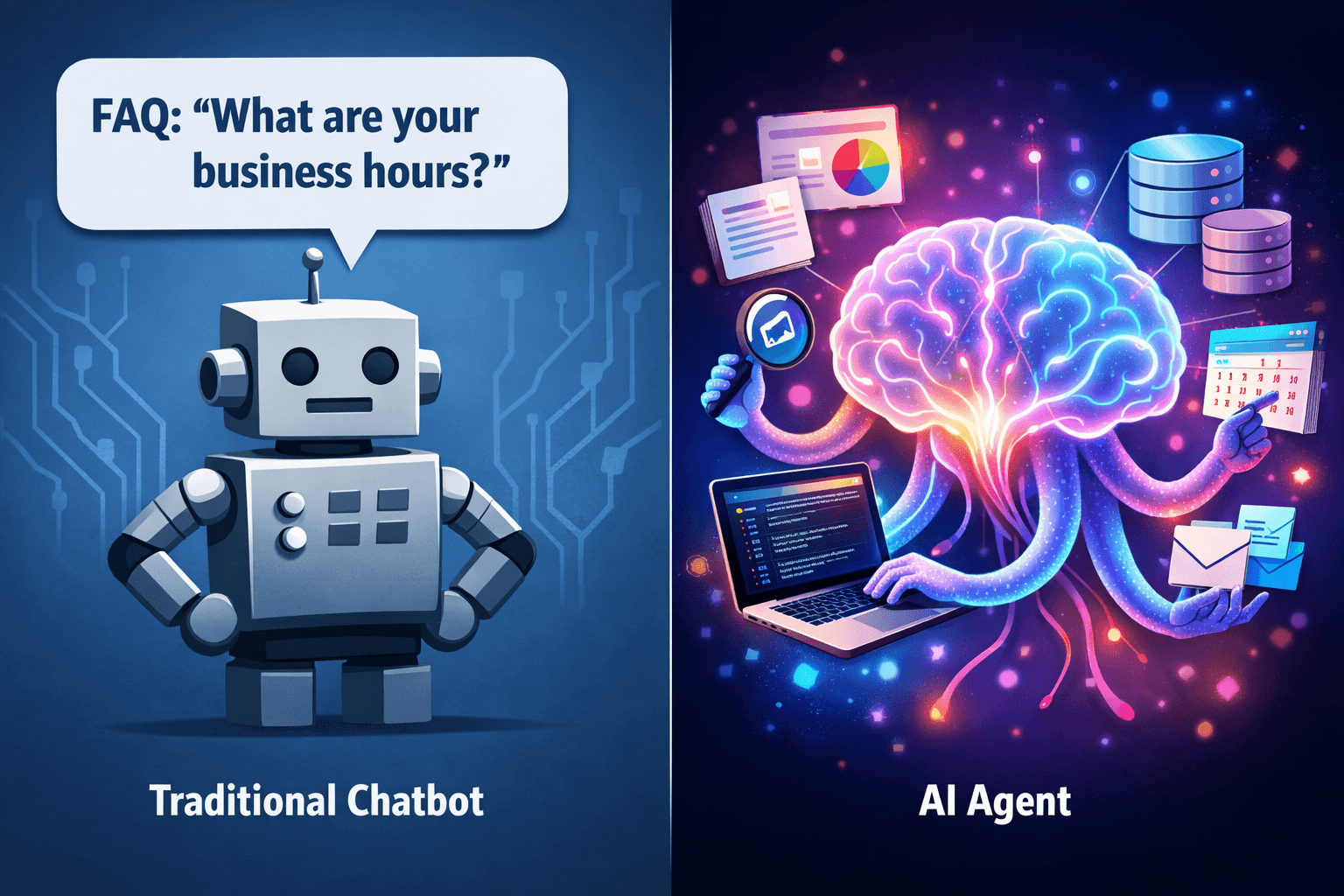
The terms "chatbot" and "AI agent" are often used interchangeably, but they represent fundamentally different capabilities. Understanding this distinction is crucial for making the right investment for your business needs.
Traditional Chatbots: Reactive and Rule-Based
Classic chatbots follow predefined scripts and decision trees. They recognize keywords and respond with preset answers. They're great for FAQ-style interactions but struggle with anything outside their programmed scenarios. When confused, they typically loop back to generic responses or hand off to humans.
AI Agents: Autonomous and Adaptive
True AI agents powered by large language models can understand context, maintain coherent multi-turn conversations, access external tools and data sources, and take actions on behalf of users. They can handle novel situations they've never encountered before by reasoning through problems.
Key Capabilities That Separate Them
- Memory: Agents remember context across interactions; chatbots often don't.
- Action: Agents can execute tasks (book appointments, process orders); chatbots primarily provide information.
- Learning: Agents can improve from interactions; chatbots stay static until manually updated.
- Integration: Agents can query databases, call APIs, and use tools; chatbots work with limited, predefined data.
The bottom line: if you need a simple FAQ responder, a chatbot might suffice. If you want AI that can genuinely help customers complete tasks and solve complex problems, you need an AI agent.